Every so often I see a movie and recognize that I’m watching a filmmaker emerge in real time. Kill Me Again, the 2025 feature debut from former UFC fighter Keith Jardine, is one of those satisfying discoveries. It’s an entertaining, confidently mounted first film with a clear creative voice, anchored by two actors who bring more depth and emotional texture than you might expect from a time-loop thriller built around a serial killer. With Kill Me Again, Jardine built himself a strong first-time filmmaker’s playground, and the results show how far good writing, committed performances, and tonal awareness can take you.

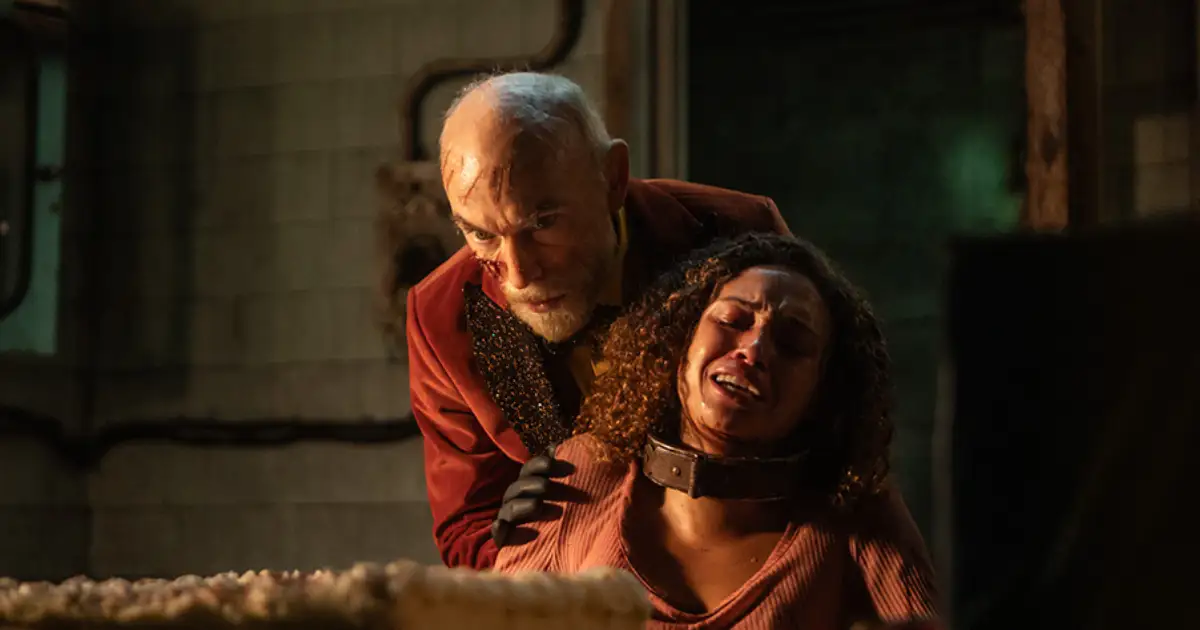
Image courtesy of Broken Ear Productions / Vertical
Brendan Fehr and Majandra Delfino are the heart of the film, and from the opening scenes their chemistry gives the story its rhythm. You can feel two performers who trust each other, but more importantly, trust the material. The film begins in familiar territory: dark humor, looping stakes, a man forced to relive the same day but Jardine approaches it from a fresh angle. Instead of centering a hero, he centers his film on a serial killer, “the Midnight Mangler”. That shift gives the loop mechanic a new emotional charge. The early beats are fun, playful, and occasionally brutal, but beneath all that is a film quietly studying how people behave when they’re trapped with themselves.
Once the loop takes hold, the film opens up in interesting ways. In my opinion, Jardine’s script is tight, not perfect, but tight in a way that suits the story he’s telling and when he takes leaps, they land. There’s a confidence in letting character drive the escalation rather than spectacle. I think that’s where his instincts as a storyteller shine the most. Instead of racing for bigger set pieces, the film trusts its characters and lets the performances breathe.
Majandra Delfino’s character, Ana, becomes the emotional anchor. Delfino brings humor, edge, suspicion, and hurt, and at times her presence pulls the film into deeper territory than you might expect. In the early scenes, I did find some of Ana’s dialogue a bit unexpected in a way that, in my opinion, risked making her seem unlikable before Charlie has truly earned her distrust. It wasn’t detrimental, but it did momentarily tilt the dynamic before the story’s own momentum corrected it. That said, I also think Jardine was reaching for complexity rather than likability, and that intention pays off as the film progresses.
The middle portion of the film is where Jardine’s directing feels most assured. There’s a clear steady tonal balance between dark humor and terror that appears effortless but can easily go off the rails. Jardine manages that mix well. You can feel a filmmaker understanding the value of restraint, holding on to a performance beat, letting a reaction tell the story, choosing camera placement that supports character rather than calling attention to itself. These are the details that excite me, because they signal a director who understands that filmmaking isn’t about doing more; it’s about choosing better.
As the loop grows more volatile, the film also reveals brief flashes of genuine emotional weight. There are scenes, particularly between Fehr and Delfino, where the story leans into vulnerability, fear, and something like longing. Those moments give the film a surprising sense of scope, as if we’re watching a story trying to understand its characters at the same time they’re trying to understand themselves. That’s where the movie becomes something more personal.
And then there’s the ending, the film’s final gift, and the clearest sign of Jardine’s potential. What I appreciate most is how he plays with predictability. The film positions you to feel like you know exactly where it’s going and the limits of its range, then pivots with a small but meaningful reveal or moment that reframes things. It’s not a shock-for-shock’s-sake twist; it’s the kind of carefully placed unpredictability that makes you realize the movie has been quietly guiding you toward something more reflective.
For filmmakers and especially first-time directors Kill Me Again is a valuable case study. Jardine chose a concept he could execute well, wrote a script tailored to that reality, surrounded himself with strong actors, and focused on character-driven storytelling instead of chasing unnecessary scale. That discipline is something us filmmakers often struggle with. The movie works because the details work: the pacing is measured, the performances are grounded, and the premise serves the story rather than overshadowing it.
Kill Me Again is an original idea formed from a familiar concept, and it delivers a confident, character-driven story with heart, humor, tension, and an unexpected killer finish. Jardine proves that with intention and restraint, a first film doesn’t need to be everything, it just needs to be entertaining, purposeful, and crafted with care. Keith Jardine has a bright future as a Writer / Director and I can’t wait to see what he creates next!